Why Your Antenna Needs a Counterpoise, and Why Small Devices Struggle
Here is a frustrating experience that many hardware teams have had. You build a wireless device, you tune everything carefully on the open bench, and the range is excellent. Then you close it into its final enclosure, the small sealed body it will actually ship in, and the range falls off a cliff. Nothing in the circuit changed. So what happened?
Nine times out of ten, the answer is not the circuit at all. It is the antenna, and specifically the half of the antenna that you may not have known existed.
An antenna needs two halves
Most small devices use a monopole, which is just a single wire or rod sticking out. It is simple and cheap, and it works well, but only when it has a partner. A monopole is really one half of a more complete antenna called a dipole, which has two arms. The second arm has to come from somewhere, and in a monopole that role is played by a flat conductive surface underneath it, called a ground plane or counterpoise.
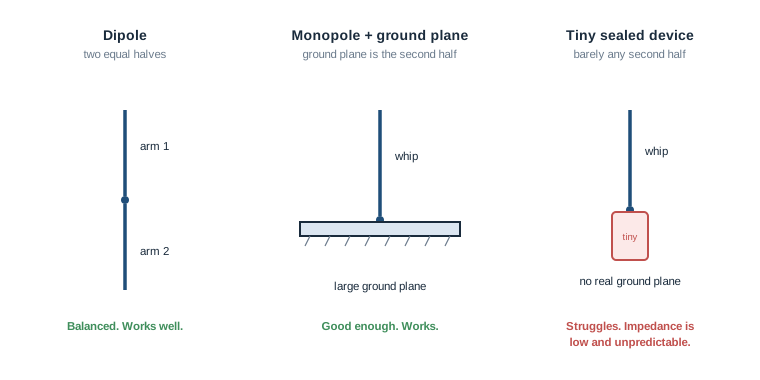
On a large circuit board this is no trouble. The board's ground copper is big enough to act as the second half, and the antenna is happy. The problem arrives when the device is tiny. A small sealed product has almost no room for a ground plane, so the antenna has no proper second half to work against. Denied one, it improvises, using whatever conductors are nearby: the battery, the circuit, even the hand of the person holding it. The result is an antenna whose behaviour is hard to pin down and changes depending on how the device is held.
Why trimming the wire is only half the story
A natural instinct is to fix a misbehaving antenna by changing its length. That instinct is partly right and partly wrong, and the difference is worth understanding.
The length of the wire controls what frequency the antenna prefers. Cut it shorter and its favourite frequency rises; leave it longer and the frequency drops. So trimming is the correct tool for putting the antenna's resonance on your target frequency.
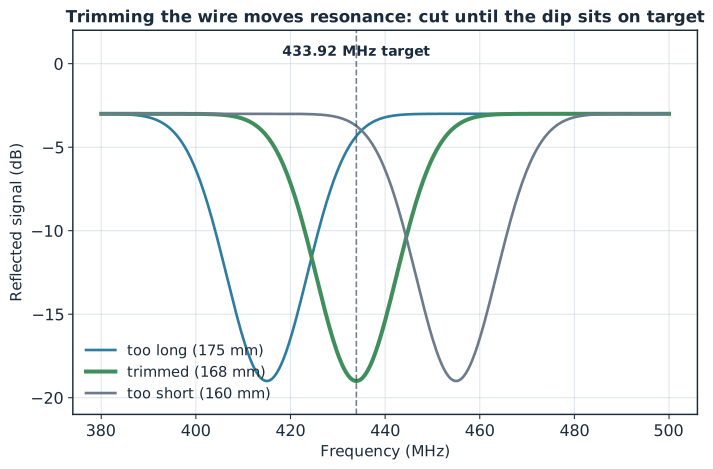
What trimming does not control is how much resistance the antenna shows at that frequency, and that is set mostly by the antenna type and its counterpoise.
This is the catch that traps people. A small monopole on a poor counterpoise will happily resonate at your target frequency once you trim it, but at that frequency it might present, say, 20 ohms rather than the 50 ohms your radio wants. No amount of trimming changes that number. Length sets the frequency; the resistance is a separate problem that the matching network has to solve. Anyone who tells you that you can just trim a bare wire until it is 50 ohms has skipped over this.
Why the measurement itself can lie
It gets one level trickier. Suppose you decide to measure the antenna properly with a NanoVNA to see what you are dealing with. You connect the instrument to the antenna with a coaxial cable and take a reading. There is a hidden problem in that simple act.
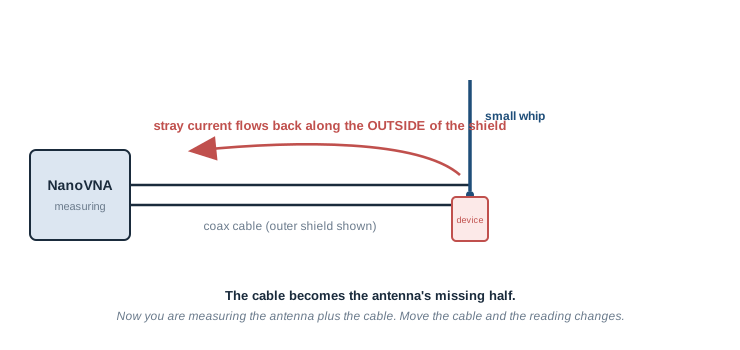
Remember that the antenna is desperate for a second half. When you connect a cable, the outside surface of that cable's shield is a long conductor, and the antenna grabs it to use as its missing half. Current that should stay on the antenna instead flows back along the outside of the cable. The moment that happens, you are no longer measuring the antenna on its own. You are measuring the antenna plus your cable, as a pair. The tell-tale sign is that the reading changes when you move the cable, or when you change its length. A measurement that depends on where you put the cable is not a measurement of the antenna.
This is not a flaw in the NanoVNA. It would happen with any instrument, because it is physics. A small monopole simply has no single fixed impedance on its own. Its impedance is only defined together with whatever is acting as its counterpoise, and a stray cable is all too willing to volunteer.
The way to think about it
The thread running through all of this is a single idea: a monopole and its counterpoise are a team, and you cannot understand one without the other. On a big board the team works quietly because the ground plane is a good partner. On a tiny device the partner is missing, so the antenna recruits whatever it can find, including the very cable you are trying to measure with.
Once you see the problem this way, the solutions start to make sense. You either give the antenna a deliberate, proper counterpoise so it stops improvising, or you arrange the measurement so the cable is no longer free to join in, or you sidestep the whole issue by judging the antenna in a completely different way. Those are exactly the techniques the next article covers: how to measure a small antenna honestly, and how to know when the number you are looking at can be trusted.