Tuning an RF Matching Network with a NanoVNA: Start Here
At SRQ Robotics we tune our radios with spectrum analysers and vector network analysers, the kind of bench equipment that can cost more than a small car. The good news for anyone building their own wireless project is that you do not need any of that to get real results. A NanoVNA and a tinySA, together cheaper than a nice dinner out, will take you most of the way. This short series shares how we approach antenna matching, starting from the ground up.
This first article has one job: to make the basic idea clear, and to take the fear out of the words you keep running into. By the end you will know what your radio is actually doing when it sends power to its antenna, and why a small circuit sits between the two.
The echo problem
A radio chip makes a signal. That signal has to travel down a track on the circuit board and into the antenna, where it leaves as radio waves. You would think the signal simply flows out, the way water flows down a pipe. At radio frequencies it is not that simple.
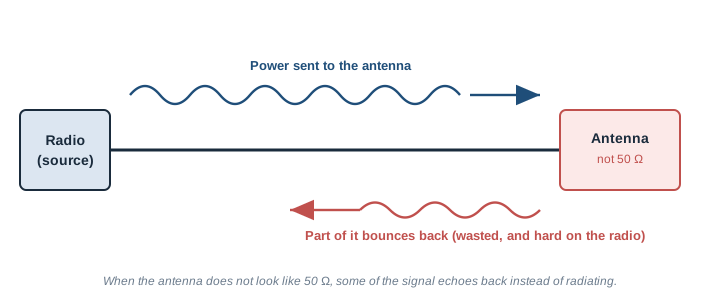
If the antenna does not "look" electrically the way the track expects, part of the signal hits the antenna and bounces straight back, like an echo off a wall. That bounced signal is a problem twice over. First, the power that came back never left as radio waves, so your range drops and your battery drains faster for nothing. Second, the returning power flows back into the amplifier, where it turns into heat and, if it is bad enough, damage.
The number the whole industry is built around is 50 ohms. Almost every radio, cable, and connector is designed for 50 ohms. So the job of matching is simple to state: make the antenna look like 50 ohms, and the echo goes away.
The three words you keep seeing
When you read about this online you meet a wall of jargon. Here are the three terms that matter most, each in plain language before any maths.
S11 is the echo. When an instrument sends a test signal into your circuit and listens for what bounces back, the ratio of the bounce to what it sent is called S11. A big S11 means a strong echo, which means a bad match. A small S11 means almost nothing came back, which means a good match.
Return loss is how quiet that echo is. It is just S11 written in decibels, a friendlier scale. A return loss of 15 decibels means the echo is about thirty times weaker than the signal you sent. Bigger return loss is better. As a rough guide, 15 decibels means roughly 97 percent of your power reaches the antenna, which is a good place to aim.
S21 is what gets through. Where S11 is the bounce, S21 is the signal that passes from one side of a circuit to the other. When you build a filter, S21 tells you how much signal survives the trip. You want almost all of it to pass at your working frequency, and almost none of it to pass at the frequencies you are trying to block.
That is most of the vocabulary. S11 for the echo, return loss for how quiet it is, S21 for what passes.
A look at the circuit
So what sits between the radio and the antenna to fix all this? A small handful of capacitors and an inductor, arranged in a particular shape.
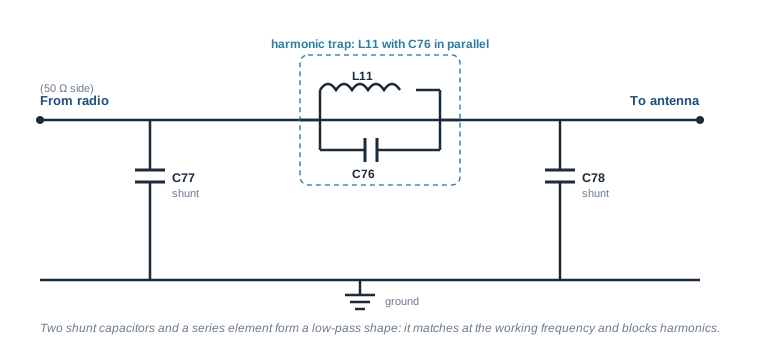
This little network does two jobs at once. The first is matching: the components transform the antenna's impedance so the radio sees its preferred 50 ohms at the working frequency. The second is filtering. No amplifier is perfectly clean. Along with your wanted signal at, say, 433 megahertz, it also produces weaker copies at exact multiples: 866 megahertz, 1300 megahertz and onward. These are called harmonics, and radiating them is both wasteful and against the rules. The shape of this network, two capacitors to ground with a series element between them, naturally lets the wanted frequency through while holding back the higher ones.
The clever part is the pair in the middle, an inductor and a capacitor sitting in parallel. This combination, called a trap, has a special trick: at one chosen frequency it blocks the signal almost completely. Place that frequency on top of the strongest harmonic and you have bought a deep, targeted block for the price of one extra capacitor.
Why we measure instead of calculate
You can work out starting values for all these components with formulas, and we do. But the formulas assume perfect parts in empty space, and a real circuit board is neither. The copper pour around the components, the tiny imperfections in each part, the length of a track: all of these shift the result. So the calculated values get you close, and then you measure the real board and nudge the components until it is right. That measuring and nudging is what the NanoVNA is for, and it is what the next article walks through.
For now the takeaway is this. Your radio needs the antenna to look like 50 ohms, a small network of parts makes that happen while also blocking harmonics, and the only reliable way to get it exactly right is to measure the real thing rather than trust the maths alone.
In the next article we put the NanoVNA on the bench, calibrate it properly, which is the step most people get wrong, and tune the network in the correct order.