Measuring a Small Antenna Honestly: Chokes, Reference Planes, and Knowing When to Trust the Number
A short recap to set the scene. A small antenna, the kind that fits in a tiny sealed device, has no proper ground plane to work against, so it borrows whatever conductor is nearby. When you try to measure it with a cable, the antenna borrows the cable, and your reading becomes a measurement of the antenna and the cable together rather than the antenna alone. So how do you get an honest number anyway? That is what this article is about.
Start by separating the unknowns
The single most useful habit in this kind of work is to never have two unknowns at once. If both your circuit and your antenna are mysteries, every test is ambiguous, because a change could be helping one and hurting the other. So you make one of them a known quantity and hold it fixed.
The easiest way to do that is with a reference antenna: a good, properly built, properly grounded antenna that you trust completely. A tuned car-roof whip is a fine example, because its large metal base gives it a proper counterpoise and it shows a clean match on the instrument. With a known-good antenna in hand, any oddity you then see must be coming from the thing you are actually testing, not from the antenna. One unknown at a time is the whole game.
Choke the cable
When you do need to measure the small antenna directly, the fix for the cable problem is to stop current from flowing back along the outside of the cable. The tool for this is a ferrite choke: a small ring of magnetic material that you thread the cable through, or clip around it. It adds heavy resistance to any current trying to travel on the cable's outer surface, while leaving the real signal inside the cable untouched.
One detail decides whether a ferrite helps or does nothing: the material has to suit your frequency. Ferrite is sold in different mixes, each tuned to a band, and most of the cheap ones in a parts drawer are made for much lower frequencies and will do nothing useful in the hundreds of megahertz. Pick a mix rated for your band. For more demanding work there are larger structures built on the same idea, such as a quarter-wave sleeve known as a bazooka balun.
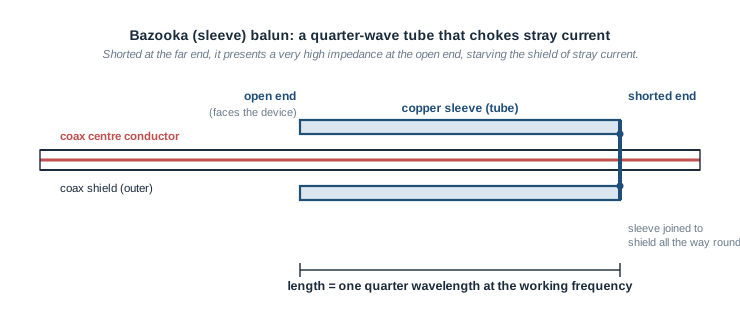
Whatever method you use, there is one acceptance test that settles everything, and it is beautifully simple. Take your reading, then move the cable, reposition it, change its route. If the reading barely changes, the cable has been tamed and you can trust the number. If the reading still jumps around, the cable is still part of the antenna and you are not done. Cable-independence is the proof that your measurement is real.
Turn the measurement into a clean handover
Once you can measure the antenna honestly, that measurement becomes a small file, and that file is the cleanest way to split the work between an antenna person and a circuit person.
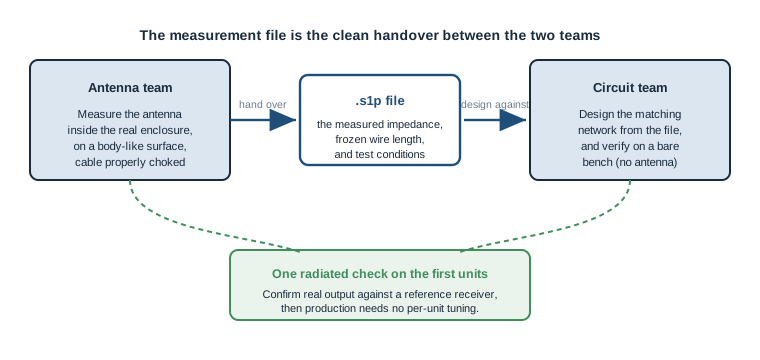
The file is called a Touchstone file, and it simply lists the antenna's measured impedance at every frequency across a sweep. The antenna person measures the real antenna inside the real enclosure, on a surface that mimics how it will actually be used, with the cable properly choked. They hand over the file along with the exact wire length that produced it and a note of the conditions. The circuit person then designs the matching network entirely from that file, on an ordinary bench, with no antenna anywhere in sight. They can even verify their work without the antenna, by checking that their network presents the mirror image of the impedance the file describes.
The two only need to come together once, at the end, for a single check on the first finished units: does the real device put out a strong signal when judged against the reference receiver. After that passes, production needs no tuning at all. Every unit gets the same parts and the same wire length, because the hard thinking was done once and captured in the file.
When you cannot connect a cable at all
Sometimes the device is so small and so sealed that no cable can reach the antenna in its real state. There is a clean answer here too: stop measuring impedance and measure what you actually care about, which is the signal that leaves the device. Put the device on its own battery so there is no cable at all, let it transmit, and read the strength on a separate reference receiver a fixed distance away. Then change one component, read again, and keep whatever makes the received signal stronger. It is a simple climb toward the best result, and because the device has no cable attached, the whole cable problem disappears by construction.
The lesson worth keeping
If there is one idea to carry away from this series, it is this. In radio work, isolate your unknowns, and when in doubt, measure the thing you truly care about rather than a convenient stand-in for it. Impedance is a stand-in for what we really want, which is power leaving the antenna cleanly. It is a useful stand-in, and most of the time measuring it is the practical choice. But when the stand-in starts misleading you, as it does with a small antenna and a stray cable, the answer is to step back to the real goal and measure that instead.
At SRQ Robotics this is how we approach the parts of a design that resist easy measurement: pin down what can be known, refuse to let two mysteries hide behind each other, and keep the real objective in view. The instruments help, but the discipline is what gets a clean signal out of a very small box.